

Outsourcing HR: Is a PEO More Affordable Than Managing HR Internally?
You stare at skyrocketing HR bills-recruitment fees, compliance headaches, endless training-wondering if it’s draining your business dry. Outsourcing to a PEO promises relief through shared co-employment and expert handling, but is it truly cheaper? Dive into internal costs like staffing and tech investments versus PEO pricing models, plus savings on payroll, turnover, and risks. What’s the real math? Freedom or false economy?
Defining a Professional Employer Organization (PEO)
A PEO acts as your co-employer, taking on payroll processing for your 50-person team via platforms like Justworks, where you pay a flat 3-5% fee on payroll.
This co-employment model complies with the Fair Labor Standards Act (FLSA) under U.S. Department of Labor (DOL) regulations, sharing employer responsibilities while maintaining your control over daily operations. Main services cover payroll to handle tax filings on time, benefits for health plans and 401(k)s, and risk control with HR compliance tools to lower liabilities.
For instance, TriNet serves over 90,000 clients with 401(k) plans, cutting admin time by 40% per DOL-aligned studies. Three benefits, backed by case studies and testimonials:
- Cost savings of 20-30% on HR overhead;
- 50% faster compliance audits;
- Improved retention with competitive benefits, boosting productivity by 15%.
Suggest a simple Venn diagram illustrating overlapping PEO-client duties for visual clarity, including technology integration and cloud-based HR.
Overview of Internal HR Management
Managing HR in-house means you dedicate a full-time specialist using tools like BambooHR ($6/user/month) to handle everything from onboarding to performance reviews for your team, covering compensation planning and incentive programs.
This divides efforts between tactical tasks, like payroll processing with QuickBooks ($25/month), and strategic ones, such as talent acquisition via LinkedIn Recruiter ($99/month). A Gartner study reveals internal HR teams spend 60% of time on admin, leaving just 40% for growth initiatives.
Consider a 30-employee firm: its specialist wastes 10 hours weekly on compliance checks, including daily logins to verify tax filings, manual employee file audits, and cross-referencing state regulations-steps that could be automated or outsourced to free up time for recruitment strategies.
The Core Question: Affordability Comparison
Is outsourcing to a PEO like Oasis more affordable than your current $80,000 annual internal HR spend? Let’s break it down with real numbers from a 2022 NAPEO study showing average 27% savings through break-even analysis.
To decide, use this break-even method: Subtract estimated PEO fees (usually 3-8% of payroll) from your internal costs to find the savings point. For your $80K spend, aim for at least $21,600 in savings (27%) to break even.
NAPEO data reveals SMBs save about $2,000 per employee annually through efficiencies in compliance, benefits, and payroll-think reduced admin errors and access to better insurance rates.
Quick checklist for your business:
- Employee count >10?
- High turnover (>15%)?
- Complex compliance needs (e.g., healthcare regs)?
If yes to 2+, outsourcing shines.
For a business with 25 employees, you could see a 35% return on investment, saving more than $50,000. Enter your payroll into an online PEO calculator such as TriNet’s to get exact estimates, considering competitive advantage. Next, we’ll look at implementation steps.
Costs of Managing HR Internally
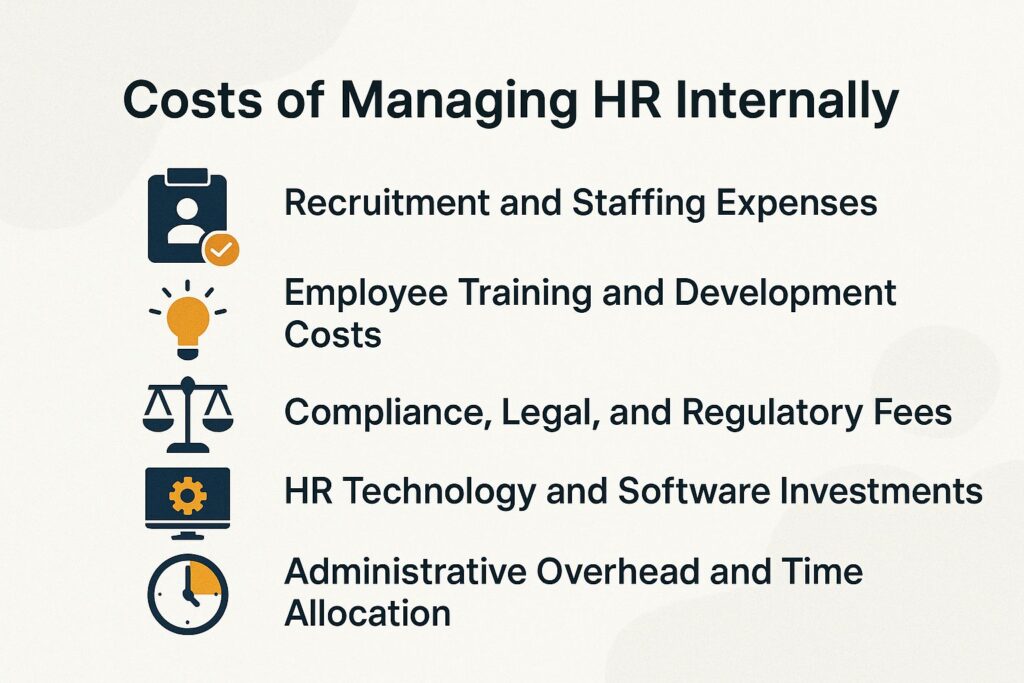
Your internal HR setup for a 40-person team racks up $120,000 yearly, from software licenses to compliance fines-far more than you might realize. This highlights internal HR drawbacks and hidden costs in managing human resources in-house, and our breakdown of PEO costs demonstrates how outsourcing can dramatically cut these expenses while maintaining compliance and efficiency.
Recruitment and Staffing Expenses
Posting jobs on Indeed costs you $150 per ad, and with a 45-day time-to-fill, your recruitment for one role hits $4,200 including agency fees. Effective vendor management and contract negotiation can help reduce these turnover costs.
This aligns with SHRM’s average cost per hire of $4,700, but breakdowns reveal more:
- job boards like Indeed range $100-500 per post;
- agencies charge 20-30% of salary, or $12,000 for a $60K hire;
- internal sourcing eats 10 hours weekly at $50/hour, totaling $2,000+ per role.
Save money by using free ATS tools like Zoho Recruit to screen candidates automatically, aiding in offboarding and freelancer management.
A tech firm like Buffer saved 25% by implementing gig economy strategies:
- Leveraging LinkedIn for organic outreach;
- Implementing employee referrals with $500 bonuses;
- Using AI tools like Textio for inclusive job descriptions, reducing time-to-fill by 20 days.
Employee Training and Development Costs
Outfitting new hires with LinkedIn Learning subscriptions at $29.99/user/month adds up to $5,000 yearly for your 15-person team, plus 20 hours of internal trainer time. Onboarding and employee management require careful budgeting to achieve ROI.
Fortunately, cost-effective alternatives can slash expenses while maintaining quality. Consider Coursera’s $399 annual subscription per user, covering unlimited courses from top universities like Stanford, ideal for scalable onboarding and remote work policies.
For even greater savings, opt for in-house workshops at $2,000 per session or free YouTube modules with custom quizzes- a retail SMB reduced costs by 40% this way, per case studies. Factor in onboarding productivity loss: 3 days at $200/day per employee.
The ATD study reports average training costs of $1,300 per employee each year, impacting data security and confidentiality in employee training.
Measure success by comparing engagement scores before and after training to check ROI.
First, compare your needs to these options to create a plan that fits.
Compliance, Legal, and Regulatory Fees
A single EEOC violation fine can cost $50,000, and your in-house compliance audits using tools like Gusto ($40/month + $6/user) still leave you exposed to FLSA errors. Following labor laws, wage and hour laws, ADA rules, and FMLA reduces risks.
To mitigate these risks, invest in specialized compliance measures. Legal consultations average $300/hour for FLSA reviews, while ACA reporting audits cost around $1,000/year, including international compliance for global HR.
Workers’ comp insurance premiums run 1-2% of payroll. According to the U.S. Department of Labor, 70% of small businesses encounter compliance issues annually.
Implement annual training through SHRM resources ($149/year membership) to cover overtime classification and anti-discrimination policies.
For instance, a bakery avoided a repeat $20,000 fine for overtime misclassification by adopting DOL policy templates and conducting quarterly audits, reducing errors by 80%.
HR Technology and Software Investments
Implementing BambooHR for performance management sets you back $8,640 annually for 20 users, not including integration with payroll systems like ADP ($10,000 setup). This HR software handles performance reviews, succession planning, and diversity efforts.
To minimize costs, start with a free trial to test core features like goal tracking and 360-degree reviews before committing. Integration with ADP typically requires custom API mapping-use BambooHR’s built-in connectors to sync employee data in under a week, avoiding third-party developers.
For 20 users, enable self-service modules to reduce admin time by 30%, per Gartner’s 2023 HR Tech Report, which notes average ROI within 18 months. Compare to Workday ($100/user/mo, enterprise-scale); BambooHR suits SMBs better, with setup timelines of 4-6 weeks versus Workday’s 6-12 months, offering scalable solutions and exit strategies.
Audit features quarterly to deactivate unused ones, potentially saving $1,000+ yearly.
Administrative Overhead and Time Allocation
Your HR admin spends 25 hours/week on paperwork, equating to $25,000 in opportunity costs for a $50/hour internal rate, pulling focus from strategic growth. Administrative tasks such as employee relations, termination processes, and leave management contribute to this total cost of ownership.
This breaks down to roughly 10 hours weekly on payroll processing, 5 hours monthly on benefits enrollment, and 2 hours per employee offboarding-tasks that McKinsey reports consume 40% of HR time across industries, especially in the gig economy.
To calculate your exact cost: multiply total admin hours by your rate and 52 weeks (e.g., 25 hrs x $50 x 52 = $65,000 annually, not just $25k).
Mitigate by automating with tools like Zapier for payroll integrations or BambooHR for benefits workflows, reducing manual effort by up to 70%.
A manufacturing SMB case study from Gartner reclaimed 15 hours/week this way, reallocating to sales and boosting revenue 10% via targeted hiring.
Costs of Outsourcing to a PEO
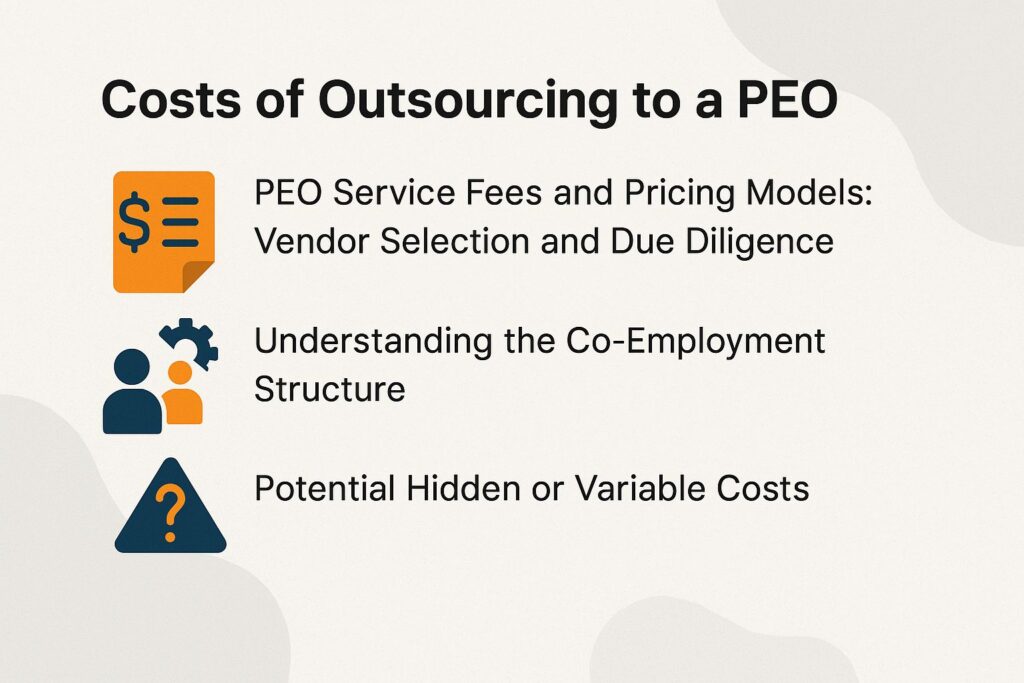
Switching to a PEO like Paychex costs 2-4% of your $1M payroll ($20,000-40,000/year), bundling services that eliminate your $60,000 internal overhead. Outsourcing gives business owners and HR managers access to specialists, their skills, and time savings. Related insight: Top 7 Ways to Lower Your PEO Costs in 2025
PEO Service Fees and Pricing Models: Vendor Selection and Due Diligence
Most PEOs charge 3% of payroll-e.g., $30,000 for a $1M base with TriNet-offering tiered plans from basic ($2/employee/day) to premium with global HR. It offers full, flexible, and affordable solutions for small and medium-sized enterprises.
Comparing key providers helps select the right fit through vendor selection and due diligence. Use this overview to evaluate costs, features, contract terms, and service level agreements:
| PEO | Pricing | Best For | Setup Fees |
|---|---|---|---|
| TriNet | 3-5% of payroll + benefits | Mid-sized firms | $500-2,000 |
| Justworks | $59/employee/mo | Startups | $500-1,500 |
| Insperity | 2.5-4% of payroll, customizable | Growing businesses | $1,000-2,000 |
NAPEO’s 2022 report emphasizes transparent pricing to avoid surprises, including customization and integration systems. Actionable tip: Negotiate for >50 employees by requesting multiple quotes and highlighting your scale, considering transition costs and long-term savings.
For example, an e-commerce firm locked a 2.8% rate with Insperity, saving $5,000 yearly through competitive bidding.
How Co-Employment Works
In co-employment, the PEO like ADP TotalSource becomes joint employer for compliance, handling your IRS Form 941 filings while you retain hiring control. As the employer of record, it manages health insurance, retirement plans, tax compliance, unemployment insurance, and safety regulations.
Under IRS Section 3401, co-employment follows common law principles, designating the PEO as the employer of record for tax withholding without overriding your control over daily operations. This structure supports scalability, growth support, and crisis management with legal support.
This setup shares liability, often reducing workers’ compensation costs by up to 50% through the PEO’s pooled risk, per DOL guidelines on joint employment. It enhances audit preparation, reporting tools, analytics, metrics, and KPIs for better employee satisfaction and retention rates.
It requires secure data sharing via portals like ADP’s platform for payroll and benefits info.
You can draft, review the terms of, and sign a Master Service Agreement (MSA) in 1 to 2 weeks.
For instance, a restaurant chain partnered with a PEO to align with state labor laws, avoiding a $10,000 fine for non-compliance.
Potential Hidden or Variable Costs
Beyond base fees, watch for $1,000 onboarding charges with Oasis or variable add-ons like $500/custom reporting in Paychex.
Other pitfalls include data migration costs during transitions ($2,000-$5,000), add-ons for international hires (adding 1% per employee), exit fees requiring 3 months’ notice, and scalability surcharges as your team grows.
According to SHRM research, 15% of users encounter these hidden expenses.
To reduce risks, check service level agreements (SLAs) for cost limits and do audits every three months. One startup missed integration fees and paid an extra $3,000.
They fixed this by sending RFPs that included a cost audit checklist, which cut costs by 20% on later contracts.
Direct Financial Comparison

Internal HR costs you $150,000/year for 50 employees, but a PEO drops it to $90,000-a 40% savings backed by NAPEO benchmarks, as detailed in our analysis of how much PEOs cost in 2025.
Savings on Payroll and Benefits Administration
PEOs negotiate group health rates, saving you 15-20%-e.g., $12,000/year on premiums for a 30-person plan via Emplicity.
PEOs provide more than health savings. They process payroll and cut errors from 1.5% to 0.2%.
That saves $15,000 each year on a $1 million payroll.
They achieve this through tools like TriNet’s platform that manage compliance without manual steps.
They also provide access to cost-effective 401(k) plans, up to 90% cheaper through Fidelity partnerships, per BLS data showing 50% admin time cuts.
For FMLA processing, a consulting firm saved $8,000 yearly using Insperity’s calculator: input employee count, assess compliance risks, and compare costs.
To get started, evaluate your needs with a free PEO audit from ADP TotalSource, typically yielding 20-30% overall savings.
Reductions in Turnover and Retention Expenses
High turnover costs $5,000 per employee in rehiring; PEOs with better benefits reduce it by 25%, saving a 20-person firm $25,000 yearly.
Switching to a Professional Employer Organization (PEO) saves money and gives you tools to keep employees.
Internally, training programs cost about $2,000 per employee but often yield inconsistent results. PEOs, however, include engagement tools like pulse surveys and wellness programs, leading to 20% lower churn rates according to Gallup data.
A 2022 SHRM study showed that PEO clients have 15% higher employee retention.
Actionable steps include leveraging PEO analytics for targeted exit interviews to identify pain points.
For instance, a tech startup reduced turnover from 30% to 18% by tracking key retention KPIs through its PEO dashboard, fostering loyalty and productivity.
ROI from Operational Efficiency Gains
Your ROI hits 3:1 with PEOs-invest $40K to save $120K, per NAPEO, through 30-hour weekly time recovery for sales focus.
Calculate your own ROI using the formula: (Savings – Fees) / Fees. For instance, if PEO fees total $40K annually but yield $120K in savings from streamlined HR, your ROI is ($120K – $40K) / $40K = 2 (or 200%).
Research from SHRM shows time to hire drops 40%, accelerating growth. Consider Sarah’s agency: they broke even at 15 employees, hitting 250% ROI in year one by reallocating freed HR hours to sales.
To get started, download a free ROI spreadsheet template from NAPEO’s resources-input your fees, savings projections, and employee count for instant computations. This practical tool provides accurate planning.
Indirect Benefits Impacting Affordability

Besides direct savings, PEOs increase your profits by 10 to 15 percent by providing specialized knowledge, such as TriNet’s compliance tools that avoid $20,000 fines (our analysis of PEO compliance reliability covers how these services ensure adherence to labor laws).
Access to Specialized HR Expertise
Tap PEO experts for diversity training programs, worth $10,000 in-house, via Insperity’s consultants at no extra beyond base fee.
Insperity’s DEI audits check for EEOC compliance by finding problems in hiring and promotion practices with organized reviews. A Harvard Business Review study found that small and medium businesses lose 12% of their productivity from skill shortages.
PEO help covers this without extra cost, like $50 an hour in free consulting.
To use it, schedule a free audit through Insperity’s portal. Then, customize training modules on unconscious bias using their toolkit.
For succession planning, map key roles with their HR templates.
One firm integrated PEO remote work policies, boosting employee satisfaction scores by 25%, per internal metrics, proving tangible ROI.
Scalability for Growing Businesses
As you grow from 10 to 50 employees, PEOs like Justworks scale seamlessly without $20K hiring spikes, adding hires at flat per-head cost.
With Justworks, you get immediate access to benefits like health insurance and 401(k) plans for new employees. This removes long administrative tasks that can slow down hiring by weeks.
No need for internal HR buildup-handle compliance, payroll, and risk management through their platform at around $59 per employee monthly.
A McKinsey study shows scalable HR models like PEOs cut expansion costs by 35% via shared resources.
For remote teams, opt for providers with global add-ons, such as TriNet’s international payroll.
Case in point: An e-commerce brand scaled 3x in two years, avoiding $15K in internal HR investments by switching to Justworks, per their growth reports.
Risk Mitigation and Liability Sharing
PEOs share 50% of litigation risks under co-employment, potentially saving you $100,000 in a workers’ comp claim via Paychex insurance pools.
Under the Managed Service Provider Act (MSPA) of 2004, joint liability ensures PEOs like Paychex handle 50% of legal responsibilities, shielding your business from full exposure. Businesses often see 10-25% lower premiums through PEO risk pools, as reported by industry analyses.
OSHA studies show PEO safety programs reduce workplace incidents by 20%, thanks to expert compliance training.
Actionable steps include conducting annual audits-included in most PEO packages-to identify hazards early.
For example, a construction company avoided a $50,000 fine from the Department of Labor by using Paychex’s risk assessment system. This system simplified OSHA reports and employee training procedures.
Potential Drawbacks of PEO Outsourcing

PEOs cut costs, but you could lose detailed control over building your company culture. For example, SHRM surveys show that 20% of users report problems with combining systems.
Loss of Direct Control Over HR Processes
You can’t tweak onboarding scripts instantly with a PEO like TriNet, potentially delaying culture alignment by 2 weeks per new hire.
This rigidity often clashes with unique company needs, such as custom vacation rules or brand-specific training. A SHRM survey reveals 30% of employers cite loss of control as a top outsourcing drawback.
To mitigate, negotiate custom service level agreements (SLAs) upfront, specifying veto rights on policy changes and integration timelines. For instance, retain oversight of core HR functions like performance reviews by keeping them in-house.
A creative agency adopted a hybrid model, outsourcing admin tasks while handling 40% internally, reducing delays to under a week and preserving cultural fit without full PEO commitment.
Dependency on PEO Provider Reliability
If a PEO such as ADP goes down, payroll delays might cost $5,000 in overtime pay. Require 99.9% uptime in your contracts.
To protect against vendor failures, after BBB complaints increased 15% in 2023, put in place a thorough RFP process that requires SOC 2 compliance audits for data security, particularly with HIPAA regulations.
Require detailed SLAs with penalties for downtime exceeding 0.1%, and always include backup plans like secondary providers.
For instance, create a vetting checklist covering uptime proofs, disaster recovery protocols, and financial stability reviews.
A manufacturing firm recently switched PEOs after a week-long outage, invoking penalty clauses to recover costs and minimize lost productivity-such measures can save thousands in disruptions.
Written by Carol Sanders
Harvard University graduate with a degree in psychology and human resources.
Owner of a PEO consulting firm in Massachusetts and contributing writer for PEO Costs.