
Home › PEO Services
PEO Services: Compare Top Providers, Costs & What You Get
| In short: A PEO (Professional Employer Organization) service is an HR outsourcing partnership in which the PEO co-employs your staff and takes over payroll, benefits, tax filing, workers’ comp, and compliance — while you keep full control of your business and your people. Pricing usually runs 2–12% of payroll or about $40–$200 per employee per month. The fastest way to find your real number is to compare quotes from several providers. |
Below we break down exactly what PEO services include, what they cost, how they compare to payroll and HR-outsourcing alternatives, and how to choose the right provider. PEOcosts.com is a free, vendor-neutral comparison site — we help you line up several vetted PEOs side by side instead of pushing a single brand.
| Compare PEO Quotes → |
Featured PEO Providers
A quick snapshot of four well-known providers. Starting prices below reflect entry-level plans; true PEO pricing is quote-based and scales with your headcount and benefits — use Compare Quotes for your exact figure.
|
|||
|
|||
|
|||
|




Want the full field? See our reviews of the best PEO companies, including ADP, TriNet, Paychex, Insperity, and more.
What is a PEO service?
| A PEO service is a full-service HR outsourcing arrangement built on co-employment: the PEO becomes the employer of record for tax and administrative purposes, while you keep day-to-day control of your employees and operations. |
Through that co-employment agreement, the PEO handles payroll, benefits administration, tax filing, workers’ compensation, and regulatory compliance on your behalf. Your team stays your team — you still hire, manage, promote, and direct their work. What changes is that the heavy administrative load moves off your desk. Because the PEO pools thousands of employees across its client base, small and mid-sized businesses gain access to health plans, retirement options, and insurance rates normally reserved for much larger organizations.
What does a PEO service actually handle?
| A PEO service typically manages payroll and tax filing, employee benefits, workers’ comp, HR compliance, and risk management — the core administrative functions of being an employer. |
|
|
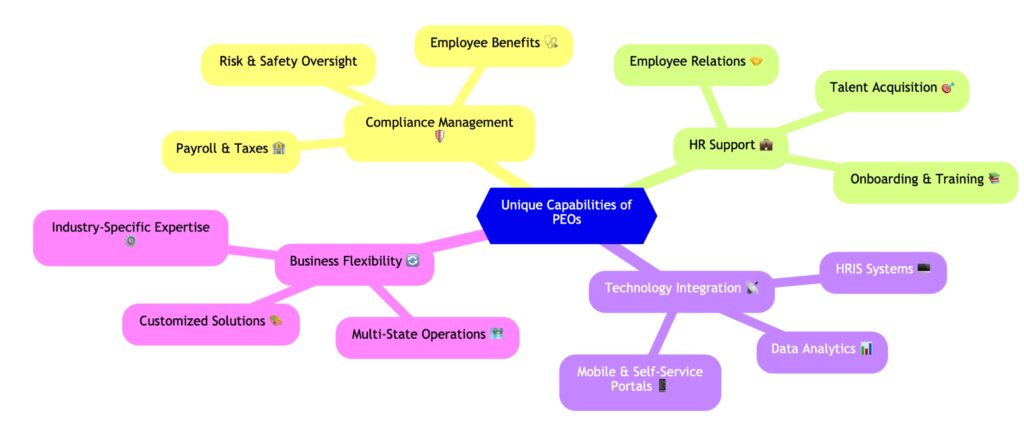
How much do PEO services cost?
| PEO services generally cost 2%–12% of your total payroll or a flat $40–$200 per employee per month (PEPM). Your rate depends on headcount, industry risk, payroll size, and which benefits you include. |
| Pricing model | Typical range | Best for |
|---|---|---|
| Percentage of payroll | 2%–12% of gross payroll | Lower-wage or variable payrolls |
| Per employee / month (PEPM) | $40–$200 per employee | Predictable, steady headcounts |
| Setup / onboarding | $0–$500 one-time (often waived) | Varies by provider |
Figures are typical industry ranges, not quotes. Actual pricing varies widely by provider and business profile — see our full PEO cost breakdown or get side-by-side quotes for your exact number.
| See My PEO Price → |
How does a PEO work?
| A PEO works through co-employment: it becomes the employer of record for payroll, taxes, and benefits, while your business keeps full control over hiring, management, and daily operations. |
In practice, your employees are reported under the PEO’s tax ID for payroll and benefits, which is what unlocks better group insurance rates. The PEO files your payroll taxes, administers benefits, and keeps you current on changing labor laws. You continue running the business exactly as before — the PEO simply carries the back-office and compliance weight so you can focus on growth.
PEO vs. payroll service vs. HR outsourcing vs. EOR
| A PEO is the only model that co-employs your staff and shares legal/tax liability. Payroll services just run payroll, HR outsourcing lets you pick individual tasks, and an EOR fully employs workers (often for hires in states or countries where you have no entity). |
| Model | Employer of record? | Best when you want… |
|---|---|---|
| PEO | Shared (co-employment) | Full HR + benefits + shared liability |
| Payroll service | No | Just paychecks & tax filing |
| HR outsourcing (ASO/HRO) | No | To pick & choose specific HR tasks |
| EOR | Full (sole employer) | To hire where you have no legal entity |
Is a PEO service worth it? Pros and cons
| For most small and mid-sized businesses, a PEO is worth it when HR admin is eating time you’d rather spend growing — the trade-off is giving up some control and standardizing on the provider’s systems. |
Pros
|
Cons
|
According to the National Association of Professional Employer Organizations (NAPEO), businesses that use a PEO have reported faster growth and lower employee turnover than comparable companies that don’t — a big reason adoption keeps climbing among small employers.
What types of businesses use PEO services?
| PEO services are used across nearly every industry, but they’re most common among small and mid-sized businesses — typically those with roughly 10 to 150 employees who want big-company HR without a big-company HR department. |
|
|
|
Looking for providers in your area? See where we serve to compare PEO services by location.
What is a certified PEO (CPEO)?
| A Certified PEO (CPEO) is a PEO that has met the IRS’s financial, reporting, and compliance standards. Certification means the PEO takes sole responsibility for federal payroll taxes, removing your risk of double tax liability. |
CPEOs must submit audited financial statements to the IRS on an ongoing basis, so certification is a useful signal of financial stability. Note that IRS certification is a standards check, not an endorsement — but it’s still one of the strongest trust markers when you’re comparing providers.
How do I choose the right PEO service?
| Choose a PEO by matching its certifications, benefits, industry experience, technology, fee transparency, and contract flexibility to your needs — then compare at least three quotes before deciding. |
Prioritize these when you compare:
- Certification — favor IRS-certified CPEOs and ESAC accreditation.
- Service fit — confirm they cover the exact HR functions you need.
- Industry experience — relevant experience means better risk management.
- Benefits quality — check plan networks, cost, and options.
- Fee transparency — insist on clear pricing with no hidden add-ons.
- Contract flexibility — know the exit terms before you sign.
New to the topic? Start with our PEO blog and buyer’s guides, or read how PEOcosts.com vets providers.

Frequently asked questions about PEO services
What is a PEO, and how does it work?
A PEO partners with your business under a co-employment agreement to handle payroll, benefits, compliance, and risk management. You keep control of operations and your people; the PEO carries the administrative and tax load.
How much does a PEO service cost?
Most PEOs charge either 2%–12% of gross payroll or roughly $40–$200 per employee per month. Your exact rate depends on headcount, industry, payroll size, and the benefits you choose — comparing quotes is the only way to get a precise figure.
What is co-employment, and how does it affect my business?
Co-employment means the PEO becomes a joint employer for administrative purposes — handling payroll and taxes under its own tax ID — while you retain full control over hiring, management, and daily decisions.
Will my employees still be my employees if I use a PEO?
Yes. Your employees remain yours for every operational decision. You still hire, direct, promote, and manage them — the PEO only handles HR administration and benefits.
Can a PEO service save my company money?
It can. PEOs use their large pooled workforce to negotiate lower rates on health insurance and workers’ comp, and they cut the cost of HR errors and compliance penalties. Whether you come out ahead depends on your current spend — comparing quotes shows the real math.
Are PEO services only for large companies?
No — PEOs are especially valuable for small and mid-sized businesses that need real HR support but can’t justify a full in-house HR team. Many providers work with companies that have just a handful of employees.
What’s the difference between a PEO and a payroll service?
A payroll service only processes paychecks and files taxes under your tax ID. A PEO co-employs your staff, files taxes under its own ID, and adds benefits, compliance, and shared liability — a much broader HR relationship.
|
Compare PEO services in about 30 seconds
Tell us a little about your business and get side-by-side quotes from vetted providers — free.
Compare PEO Quotes →
|